
Based on a Project Report for INSE6615
The History Opcode
For over a decade, an ideological war has quietly raged beneath the surface of the Bitcoin network. On one side stand the monetary purists, who believe Bitcoin should function strictly as a lean, peer-to-peer financial ledger. On the other side are the experimentalists, crypto-archaeologists, and developers who view the blockchain as an immutable, censorship-resistant bulletin board for arbitrary data.
At the absolute center of this tug-of-war is a single script command: OP_RETURN (Opcode 0x6a). Tracing its evolution from a safety valve for network bloat to an uncapped protocol playground reveals the deep structural tensions defining Bitcoin's modern era.
The Core Mechanism
In the architecture of Bitcoin Script, OP_RETURN acts as an explicit terminal switch. When the Bitcoin Script interpreter encounters this opcode during validation, execution halts and fails immediately. Consequently, any transaction output containing this opcode is rendered provably and permanently unspendable; the coins attached to it can never be unlocked or redeemed in a future transaction.
To understand why such a mechanism was introduced, one must look at how early users bypassed Bitcoin's constraints. Before OP_RETURN existed, individuals seeking to store arbitrary metadata on-chain resorted to fake P2PKH transactions. They would convert text strings into fake addresses and send dust amounts of Bitcoin to them. Because the network could not algorithmically recognize that these addresses were fake, every full node was forced to store these unspendable outputs in its active database forever, causing massive state bloat.
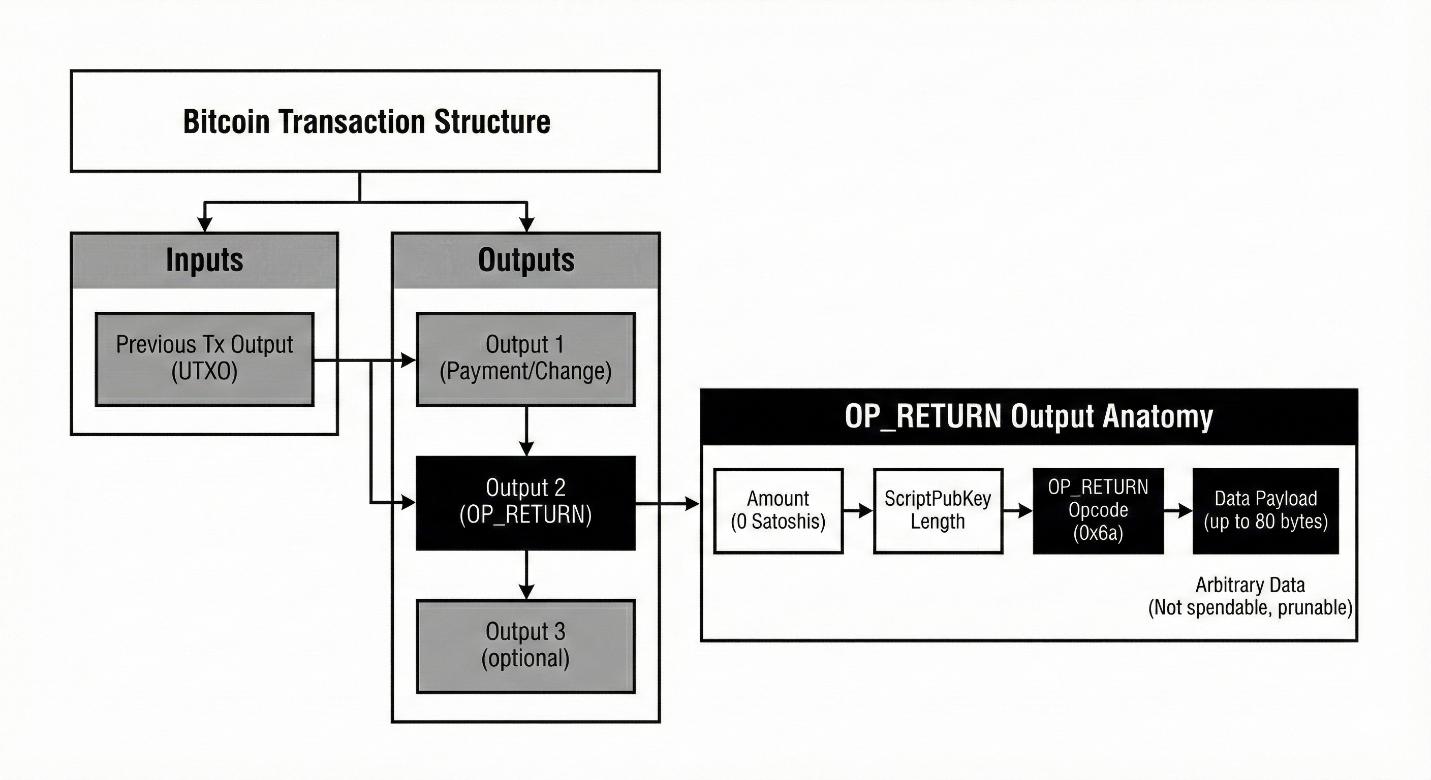
OP_RETURN elegantly solved this system hygiene problem:
-
It allows for prunability, meaning outputs are explicitly recognized as unspendable, so nodes do not add them to the active UTXO database.
-
It ensures state preservation because they exist strictly within historical block data, which allows archival nodes to handle the disk footprint while allowing pruned validation nodes to save precious RAM.
-
It maintains policy enforcement because, while core consensus rules technically allow any data payload that fits within a block, the Bitcoin Core client relies on standard relay rules, such as the datacarriersize limit, to prevent the network from being overwhelmed by data spam.
The Historical Timeline of Data Anchoring
The journey of OP_RETURN is marked by shifting engineering compromises, community consensus debates, and protocol upgrades.
Satoshi Era (2009–2013) - In Bitcoin's earliest software versions, OP_RETURN was a standard flow control opcode rather than an allocated storage slot. Satoshi Nakamoto did not use OP_RETURN to embed the iconic 'Chancellor on brink of second bailout for banks' headline in the Genesis block. That message was written into the coinbase parameter. Instead, early data pioneers routinely abused the live UTXO set via fake P2PKH dust transactions.
Standardization (2014) - May 2014 (Core 0.09.0) [3] Developers realized people would store data regardless of rules. They decided to provide a way to do it that would be prunable (safe for nodes to discard). OP_RETURN was made standard. The limit was set to a strict 40 bytes-enough for a SHA-256 hash (32 bytes) + some overhead. This was fiercely debated.
Expansion (2015–2016) - February 2015 (Core 0.10.0) [3] The limit was raised to 80 bytes (effectively 83 bytes with opcode overhead). The main driver behind this was increasing pressure from protocols like Counterparty and Omni (which Tether originally used) that needed more space for asset metadata.
Post-SegWit & Post-Taproot (2017–2023) - With the rise of SegWit (2017) [4] and Taproot (2021) [5], data storage largely moved to the "Witness" field (which is discounted in fees). This led to the explosion of Ordinals [6] (Inscriptions) in 2023, which bypassed OP_RETURN limits entirely by getting data into Witness scripts.
Runes Update - April 2024 - The Runes Protocol explicitly moved back to using OP_RETURN rather than Witness data. It essentially "cleaned up" the UTXO set by being efficient [7].
Uncapped - October 2025 (Bitcoin Core v30.0) - Bitcoin Core developers merged a change effectively uncapping the OP_RETURN relay limit (default raised to 100,000 bytes) [3], which is the block size/standard transaction limit. This has reignited the debate between people who welcome data and those who did not favor bloat.
Survey of Use Cases
This list covers the primary protocols that have utilized OP_RETURN over the last decade.
| Protocol | Use Case | Mechanics |
|---|---|---|
| Proof of Existence (2013) [9] | Bitcommitment | Hashes a document to prove it existed at a specific time [10] |
| Counterparty (2014) | Assets / DEX | Embedded asset transfers and DEX orders in OP_RETURN [11] |
| Omni Layer (2014) | Stablecoins | USDT originally lived entirely in OP_RETURN data on Bitcoin [12] |
| Veriblock (2019) | "Proof of Proof" | Used massive amounts of OP_RETURN to secure altcoins (~20–50% of block space at peak) [13] |
| Memo.cash | Social Media | Encoded text posts and "likes" directly on-chain [14] |
| Runes (2024) | Fungible Tokens | Uses OP_RETURN to track token balances efficiently [7] |
| Silent Payments (WIP) [15] | Privacy | OP_RETURN to signal shared secrets or public keys for privacy protocols |
Table 1. Primary protocols utilizing OP_RETURN
System Risks: Lost Value and Structural Friction
Spam
Purists argue that arbitrary data arrays compete directly with financial transactions for scarce block space, artificially escalating fee rates and pricing out everyday users seeking monetary utility. Conversely, permissionless market advocates argue that if an operator pays the market clearing rate, their transaction is inherently legitimate. OP_RETURN provides the safest mechanism to execute this data storage without long-term damage to node infrastructure.
Lost Coins
Because the Bitcoin Script interpreter classifies an OP_RETURN output as an immediate invalid state for spending, any base layer currency explicitly directed to it is wiped from active circulation forever. If a software engineer inadvertently transposes fields in a custom application, such as mapping a valuable payment value into an output field meant for an informational document hash, those funds are permanently destroyed on-chain, despite the underlying transaction remaining valid.
Illegal Content
Since OP_RETURN allows arbitrary data, users have uploaded illegal content, copyrighted material, and malware signatures to the blockchain. This theoretically endangers the legal status of running a full node in certain jurisdictions, although no successful legal action has occurred yet.
| Category | Specific Usage | Est. Volume / Frequency | Primary Source |
|---|---|---|---|
| Illegal | CSAM / Illicit Images [16] | < 1% of inserted data (Rare but critical) | Matzutt et al. (2018) |
| Illegal | Malware C2 (Glupteba) [17] | Extremely low volume (Targeted) | Google TAG (2021) |
| Spam | VeriBlock (Proof of Proof) [13] | Peaked at ~50% of all BTC txs (2019) | CoinMetrics / Optech |
| Spam | Token Protocols (Omni/USDT) | High historical usage (mostly migrated) | BitMEX Research |
Table 2. Nefarious Uses and Protocol Abuse
The Dark Side of the Ledger
Because OP_RETURN accepts arbitrary binary payloads, the blockchain has frequently been weaponized by malicious actors seeking indestructible hosting infrastructure.
Malware Command-and-Control
Between 2019 and 2022, the Glupteba Botnet, which compromised over one million Windows endpoints, utilized OP_RETURN as an un-killable backup communications link. When law enforcement disrupted the botnet's centralized servers, infected computers scanned specific public wallet addresses controlled by the attackers. The orchestrators broadcasted transactions containing encrypted strings within their OP_RETURN outputs. Once decrypted locally by the malware, these payloads revealed the IP addresses of newly deployed command servers. Because these transactions are permanent components of the blockchain, the infrastructure was effectively immune to traditional web takedown efforts.
Distribution of Objectionable and Illegal Material
In a comprehensive forensic study, researchers led by Matzutt et al. in 2018 identified over 1,600 non-financial files embedded within the transaction history. Their sweep uncovered 274 distinct links pointing directly to Child Sexual Abuse Material, with 142 routing to Tor hidden services. More critically, researchers reconstructed raw hexadecimal payloads that rendered explicit images involving minors, creating complex legal challenges for full-node operators under strict statutory interpretation frameworks in jurisdictions like the UK and Germany. The study also flagged extensive violations of international privacy laws, such as GDPR, uncovering un-redactable logs containing physical addresses, banking credentials, and private email archives.
Ransomware Operations
The Deadbolt Ransomware campaign of 2022, which targeted QNAP network-attached storage devices, bypassed traditional web negotiation pages entirely. Instead, the attackers automated their operation on-chain. When a victim paid the designated ransom amount, typically 0.03 BTC, an automated script instantly fired a transaction back to the victim's wallet. The specific cryptographic decryption key needed to unlock the device files was written directly inside the OP_RETURN field of that confirmation transaction, removing the need for a web server that law enforcement could seize.
State Leaks and Software Exploits
The ledger has also served as an immutable vault for leaked state secrets and intellectual property, immune to DMCA requests. During the WikiLeaks Cablegate leaks, supporters uploaded classified US State Department cables directly onto the network. While early uploads frequently leveraged fake P2PKH address vectors rather than OP_RETURN, they solidified the concept of utilizing the ledger as a permanent shield against government censorship. Forensic sweeps have also discovered copyrighted source code repositories, live malware signatures, including the classic 'Stoned' virus payload, and leaked private cryptographic keys.
Analysis of OP_RETURN Transaction Activity
Implementation in Dune Analytics
After the OP_RETURN payload size was uncapped on October 10th, significant controversy emerged regarding the potential for network abuse. Many users and developers anticipated an immediate wave of "spam" transactions following this policy change. Using Dune Analytics to query the public bitcoin data:
To analyze the historical utilization and potential bloat vectors associated with the Bitcoin OP_RETURN opcode, we employed a SQL-based data extraction query via Dune. This query targets the bitcoin.outputs dataset to isolate, measure, and categorize all transactions utilizing the nulldata (OP_RETURN) output type over a specified timeframe.
WITH opreturn_sizes AS (
  SELECT
    tx_id,
    SUM((
      LENGTH(TRY_CAST(script_hex AS VARCHAR)) - 1
    )) AS opret_size_bytes,
    DATE_TRUNC('week', block_time) AS block_week
  FROM bitcoin.outputs
  WHERE
    type = 'nulldata'
    AND block_time >= NOW() - INTERVAL '2' YEAR
    --Above line used to tweak by year
  GROUP BY
    tx_id,
    DATE_TRUNC('week', block_time)
)
SELECT
  block_week,
  CASE
    WHEN opret_size_bytes <= 82
      THEN 'up to 82 bytes'
    WHEN opret_size_bytes BETWEEN 83 AND 256
      THEN '83 to 256 bytes'
    WHEN opret_size_bytes BETWEEN 257 AND 1024
      THEN '257 to 1024 bytes'
    ELSE 'over 1024 bytes'
  END AS opret_size_cat,
  COUNT(*) AS tx_count
FROM opreturn_sizes
GROUP BY
  block_week,
  2
ORDER BY
  block_week,
  opret_size_cat
Data Extraction and Pre-processing: The query utilizes a Common Table Expression (CTE) named opreturn_sizes to filter the blockchain ledger for unspendable outputs.
Filter Criteria: The query strictly selects outputs where type = 'nulldata', effectively isolating OP_RETURN payloads from standard value-transfer transactions (e.g., P2PKH, P2WPKH).
Payload Measurement: The size of the embedded data is approximated by calculating the length of the script hex string. This metric serves as a proxy for the bandwidth consumed by the arbitrary data payload.
To visualize the distribution of data embedding practices, the query segments transactions into four distinct categories based on payload size:
- Standard Compliance (≤ 82 Bytes): Captures transactions adhering to the default Bitcoin Core
datacarriersizelimit (typically 80 bytes plus opcode overhead). This represents the vast majority of legitimate use cases, such as the Omni Layer (Tether) and simple proofs-of-existence. - Non-Standard (> 82 Bytes): Further segmented into three tiers (83–256 bytes, 257–1024 bytes, and >1024 bytes). Presence in these categories indicates transactions that likely required direct miner cooperation to bypass standard node relay policies, often signaling specific protocol experiments or potential spam attacks.
Temporal Aggregation: The final output aggregates the volume of transactions (tx_count) by week (block_week), facilitating the generation of an area graph for the identification of trends, spikes in network usage, and correlations with specific external events or protocol upgrades.
Results
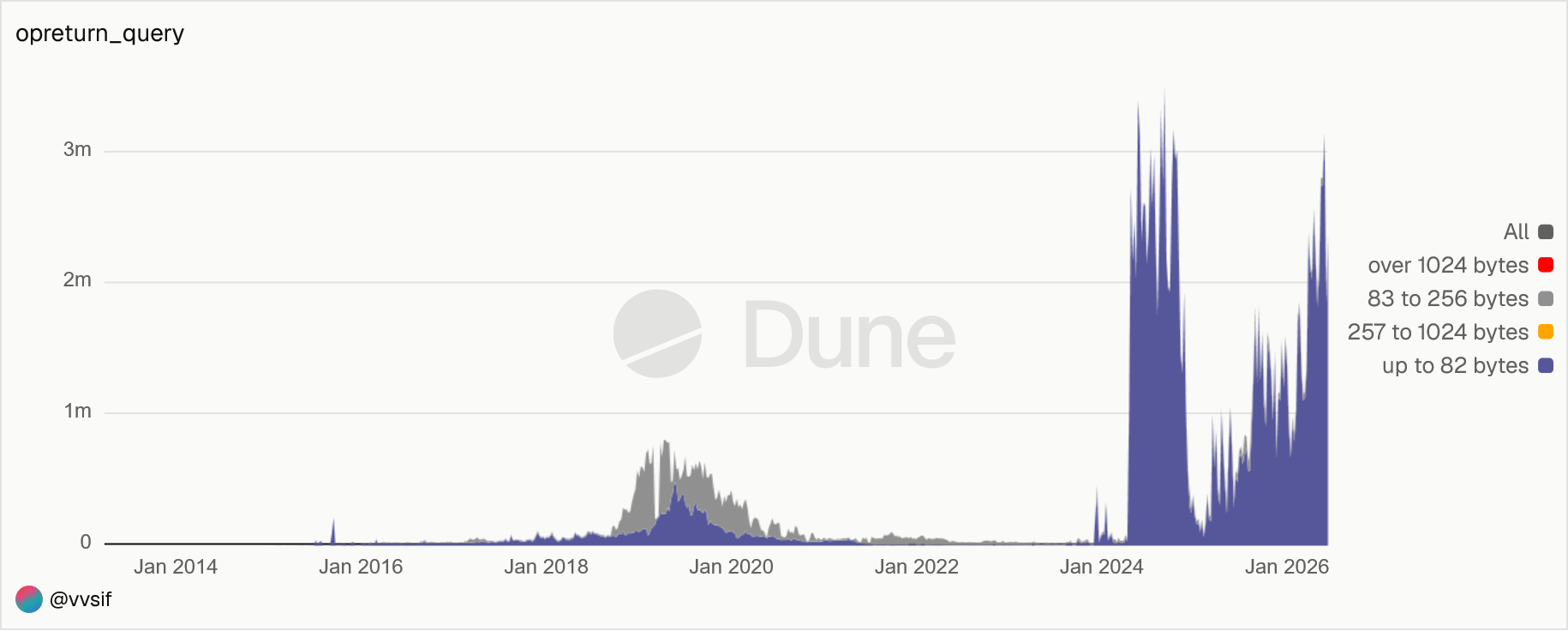
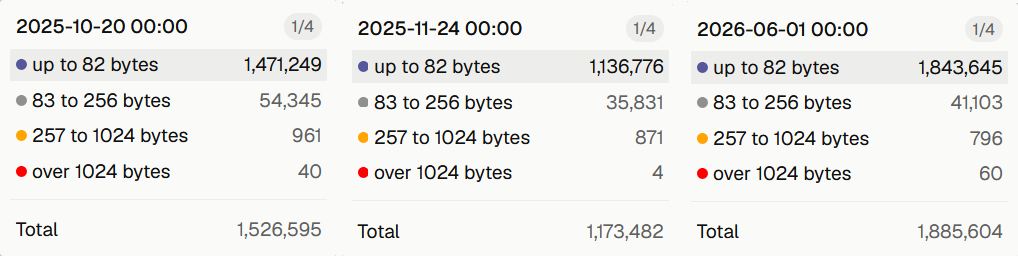
The data reveals a distinct correlation between protocol upgrades and OP_RETURN utilization. The prominent surge in transaction volume observed in April 2024 directly coincides with the Bitcoin Halving (Block 840,000) and the launch of the Runes Protocol. The dominance of the "up to 82 bytes" category during this period confirms that the majority of activity adhered to the standard 80-byte data payload (plus opcode overhead), validating that network usage was driven by standard protocol compliance rather than anomalous large-payload exploitation. Following the release of Bitcoin Core v30 in October 2025, which relaxed data carrier size policies, a second wave of activity is observable. However, contrary to concerns regarding immediate blockchain bloat:
- While there was a slight uptick in activity, current transaction levels (as of Dec 2025) remain stable and significantly lower than the peaks of mid-2025 and 2024.
- The network has not experienced a sustained increase in non-standard transactions.
- The >1024 bytes category remains negligible, typically registering single digits per week.
- The historical peak for this category occurred in May 2025 (115 transactions)-predating Core v30-while the post-release timeframe saw only a minor, transient increase (40 transactions) before returning to baseline.
Current data suggests a neutral impact. There is no immediate evidence of unchecked bloat/spam resulting from Core v30. The ecosystem appears to be utilizing the relaxed constraints for optimized small-byte transactions rather than large-scale data storage. Long-term monitoring is required to determine if OP_RETURN successfully takes over other heavier storage protocols or merely adds to the aggregate load.
Broken Windows Theory
Looking at the uncapping of OP_RETURN through the Broken Windows Theory [20] shows a potential problem: allowing larger data blobs is like leaving a broken window unrepaired, sending the message that the community cares less about keeping the blockchain a strict financial ledger. This early sign of disorder can encourage people to fill the chain with arbitrary data, weakening the informal rules that prevent spam and keep the network running smoothly. Just as a neglected neighborhood tends to attract more serious crime, this change could lead to congestion, higher fees, and drive away independent node operators, ultimately pushing the network toward centralization and disorder.
Data Displacement Hypothesis
This section builds on discussions from Bitcoin forums [22] regarding the impact of the uncapped OP_RETURN in Core v30. The hypothesis suggests that changes in OP_RETURN usage may displace other data storage methods. Specifically, if larger OP_RETURN transactions (>256 bytes) increase while usage of Witness-based storage methods (e.g., Taproot envelopes) decreases, the policy adjustment could be considered successful-signaling a shift toward prunable outputs and away from permanent Witness data bloat. Conversely, if OP_RETURN usage rises without reducing Taproot or Stampchain activity, or if it contributes disproportionately to block weight, concerns about accelerated blockchain growth would be reinforced.
Conclusion
The history of OP_RETURN proves that even a highly restricted, minor engineering compromise can become an influential variable in a network's design philosophy. What began as a simple tool to prevent nodes from running out of memory has grown into a major arena for debates surrounding censorship resistance, financial purity, and protocol scale. The latest data from Bitcoin Core version 30.0 suggests that the market has responded rationally to relaxed constraints. For now, OP_RETURN remains an elegant, functional middle ground, giving the network expressive data utility without requiring a complex overhaul of Bitcoin's core validation rules.
References
- Bitcoin Wiki. OP_RETURN. https://en.bitcoin.it/wiki/OP_RETURN
- Nakamoto, S. (2009). Bitcoin genesis block. Coinbase parameter: "The Times 03/Jan/2009 Chancellor on brink of second bailout for banks."
- Bitcoin Core Developers. (2014–2025). Bitcoin Core release notes v0.9.0, v0.11.0, and v0.21.0.
- Wikipedia. Segregated Witness (SegWit). https://en.wikipedia.org/wiki/SegWit
- Bitcoin Operations. Taproot. https://bitcoinops.org/en/topics/taproot/
- Ordinals. https://ordinals.com/
- Ordinals Documentation. Runes. https://docs.ordinals.com/runes.html
- Trezor. Pay-to-Public-Key-Hash (P2PKH). https://trezor.io/learn/advanced/standards-proposals/pay-to-public-key-hash-p2pkh
- Proof of Existence. https://docs.proofofexistence.com
- Antonopoulos, A. M. (2014). Mastering Bitcoin: Unlocking digital cryptocurrencies. O'Reilly Media.
- Counterparty Documentation. https://docs.counterparty.io/docs/basics/what-is-counterparty/
- Crypto APIs. What is Omni Layer and how does it work? https://cryptoapis.io/blog/89-what-is-omni-layer-and-how-does-it-work
- Strehle, E., & Steinmetz, F. (2020). Dominating OP Returns: The Impact of Omni and Veriblock on Bitcoin.
- Memo.Cash Protocol. https://memo.cash/protocol
- Bitcoin Wiki. BIP-0352: Silent Payments. https://en.bitcoin.it/wiki/BIP_0352
- Matzutt, R., et al. (2018). A quantitative analysis of the impact of arbitrary blockchain content on Bitcoin. Financial Cryptography and Data Security (LNCS, Vol. 10957). Springer. https://doi.org/10.1007/978-3-662-58387-6_23
- Chainalysis. (2022). Crypto crime report preview: Malware. https://www.chainalysis.com/blog/2022-crypto-crime-report-preview-malware
- Chainalysis. DeadBolt ransomware strain. https://www.chainalysis.com/blog/deadbolt-ransomware-strain-tricked-into-giving-up-decryption-keys/
- WikiLeaks. Statement on the 9-month anniversary. https://wikileaks.org/Wikileaks-Statement-on-the-9-Month.html
- Wikipedia. Broken windows theory. https://en.wikipedia.org/wiki/Broken_windows_theory
- Dune Analytics. https://dune.com/queries/6284742/10012403/
- Bitcoin Forum. https://bitcointalk.org/index.php?topic=5562380.0